
Business Casual for Men: A Complete Style Guide
Written by Brandi Hearn
“Business casual” is one of those dress codes that sounds straightforward—until you actually have to get dressed for it.
The reason is that business casual isn’t one specific look. There’s a range.
You can lean more business—structured, polished, and professional—or more casual—relaxed and approachable, while still looking put together.
I usually tell clients to consider three things before deciding where to land:
1. The setting — A client meeting may call for more polish than a regular day in the office.
2. The season — Your fabrics, layers, and footwear should make sense for the weather.
3. Your personal style — You still want to look like yourself, just appropriately dressed for the environment.
Get those three things right, and business casual becomes much easier to navigate.
Outfit #1: The More Polished Side of Business Casual
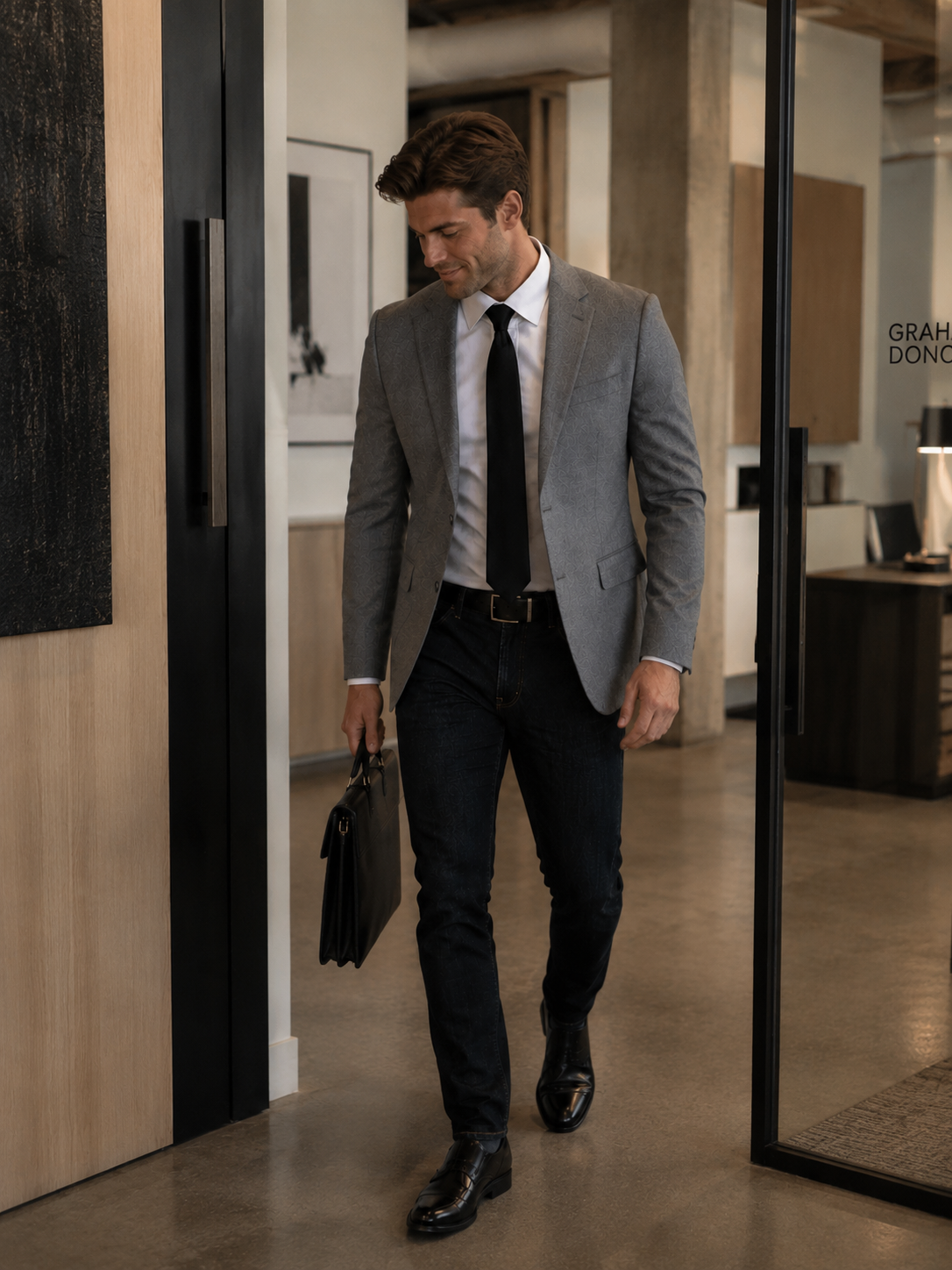
For a client meeting, presentation, networking event, or anytime you want to look a little more polished, start with structure.
Wear:
Lightweight navy blazer or sport coat
White or light blue dress shirt
Tailored chinos or wool trousers
Dark brown loafers or Derbies
Coordinating leather belt
Why it works: The jacket gives the outfit presence, while the chinos or trousers keep it from feeling like you're wearing a full suit.
One distinction I make with clients: a blazer or sport coat is not the same thing as pulling the jacket from your suit. A suit jacket is designed to be worn with its matching trousers. A separate blazer or sport coat generally has the texture and construction to work naturally with chinos and other less formal trousers.
Underneath, you don't need to overcomplicate things. A white or light blue shirt gives you a clean foundation. Keep it tucked and let the fit do the work.
Then adjust the trousers depending on the occasion. Chinos bring the formality down slightly; wool trousers take it up.
Finish with polished leather shoes. Loafers and Derbies are especially useful because they sit comfortably between dressy and casual.
Outfit #2: Refined Without the Blazer
You don't always need a jacket to look polished.
For a more relaxed office or a day without high-level meetings, a fine-gauge sweater can give you enough structure while keeping the outfit comfortable.
Wear:
Fine-gauge crewneck or V-neck sweater
Crisp dress shirt
Wool trousers, chinos, or dark denim where appropriate
Loafers or Derbies
Keep the colors understated—navy, charcoal, grey, camel, brown, or other neutrals that already work within your wardrobe.
A white or light blue shirt is an easy choice underneath. If you want a little more interest, introduce a subtle stripe or small-scale pattern.
Dark denim can work here too, but know your environment. In a more relaxed office, clean dark denim can look completely appropriate. In a traditional professional setting, I'd stay with chinos or wool trousers.
That's an important part of business casual: the same outfit isn't right for every office.
Outfit #3: The More Casual Side of Business Casual
When the environment gives you more room, you can relax the outfit without losing the polish.
Wear:
Suede jacket, Harrington, or refined casual jacket
Well-fitting knit polo
Tailored chinos or clean dark denim
Loafers or minimal leather sneakers
This is where I like to bring in a little more texture. A suede jacket, for example, gives a relatively simple polo-and-trouser combination more depth without making it feel dressy.
If suede isn't your style, a refined cotton or lightweight wool jacket can accomplish the same thing.
And don't overlook the polo. Fit matters here just as much as it does with a dress shirt. It should follow your frame without clinging, sit properly through the shoulders, and finish at a length that works with your proportions.
Your shoes can then shift the outfit in either direction. Loafers make it more polished; clean, low-profile leather sneakers make it more relaxed.
This is what I want from a well-built wardrobe: the ability to change the tone of an outfit without changing everything you're wearing.
What to Avoid in Business Casual
Ties: Not automatically wrong, but they move the outfit toward traditional business dress. Unless the environment calls for one, you can usually leave it out.
Shorts: For most professional environments, keep them for off-duty dressing.
Athletic sneakers: Running and training shoes belong with athletic clothing. If sneakers are appropriate for your office, choose something clean, minimal, and low-profile.
Distressed denim: Heavy fading, whiskering, holes, and distressing generally push denim too far into casual territory.
Untucked traditional dress shirts: If the shirt was designed with a longer hem to stay tucked, tuck it. If you prefer wearing your shirt untucked, buy one that's actually cut for it.
Anything too tight or oversized: Relaxed doesn't mean sloppy. Fit and proportion still determine whether the outfit looks considered.
The Final Take
Business casual isn't about memorizing a list of rules. It's about understanding the room and knowing how to adjust your wardrobe accordingly.
Some days that means a blazer, dress shirt, and trousers. Other days, a knit polo, chinos, and loafers are exactly right.
You shouldn't need an entirely different wardrobe for every version of your professional life. The right pieces should give you enough range to move between them. The same principle applies beyond the office, which I cover in more detail in How to Dress for Any Situation Without Overthinking It.
That's the difference between owning business-casual clothes and having a wardrobe that actually works.
Take the Guesswork Out of Getting Dressed
If you're constantly wondering whether you're too dressed up, too casual, or whether the pieces you're wearing even work together, it's usually a sign that your wardrobe needs more clarity.
Book a Private Consultation to explore the Private Wardrobe Advisory and how we can build a wardrobe around your career, lifestyle, proportions, and the environments you actually dress for.

BRANDI HEARN
Strategic Wardrobe Advisor · Los Angeles
Brandi Hearn is a Strategic Wardrobe Advisor with more than a decade of experience helping accomplished men build intentional wardrobes around their careers, lifestyles, and how they want to show up.