
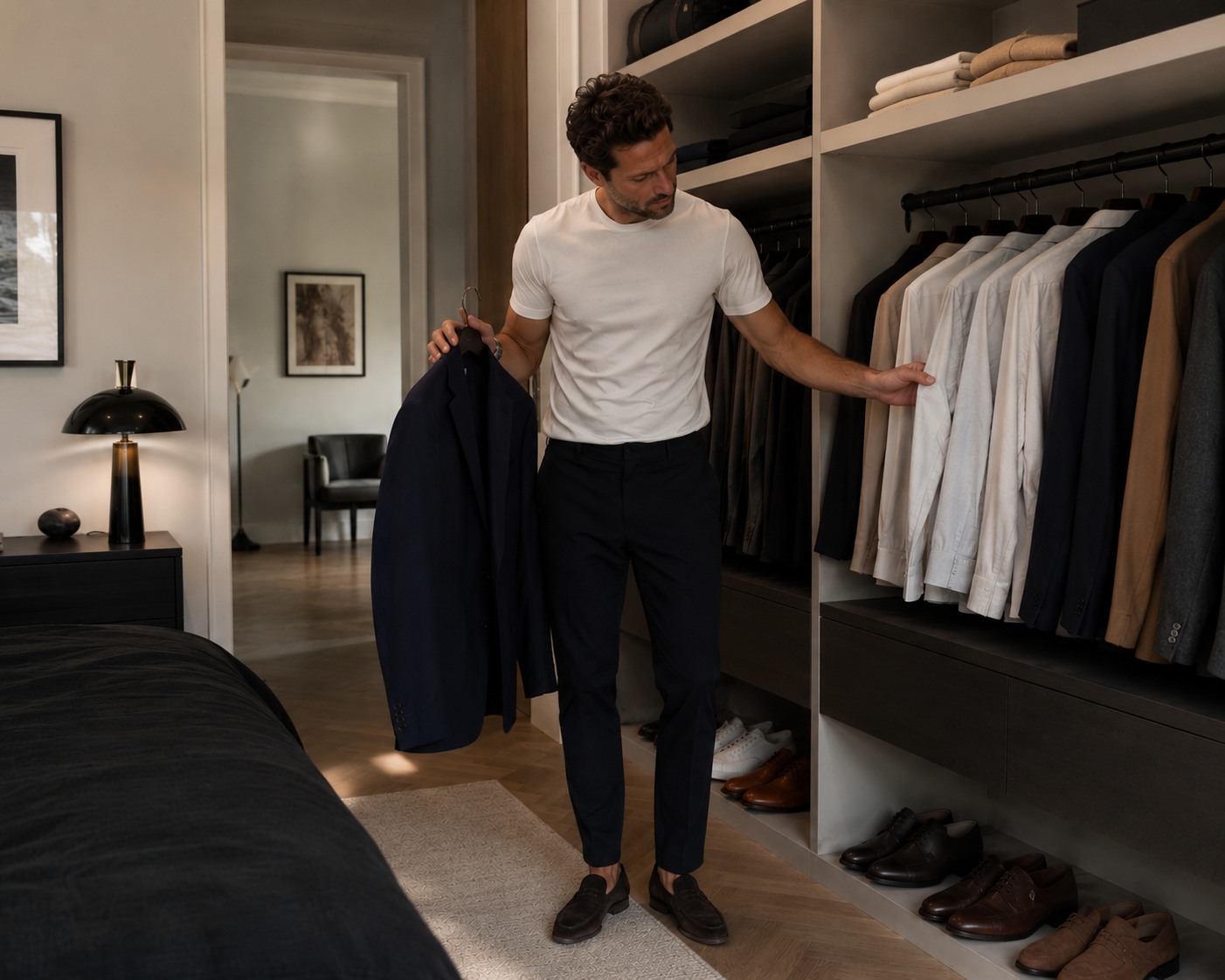
Written by Brandi Hearn
There’s an assumption that if you want to dress better, you need to shop more.
I don’t think that’s true.
In fact, when a wardrobe is working the way it should, you’ll often find yourself shopping less.
You’re no longer looking for another shirt because none of the ones you own feel quite right. You’re not buying a new pair of pants for every dinner or event. And you’re not standing in a store trying to convince yourself that something will somehow work once you get it home.
You know what you have. You know what works. And when you do buy something, there’s usually a reason for it.
That, to me, is a much better way to shop.
More Clothes Don’t Necessarily Give You More to Wear
I’ve seen wardrobes with plenty of clothing in them—and very few actual options.
There might be ten shirts, but only three get worn.
Several pairs of pants, but one is clearly the favorite.
A few jackets that looked great in the store, but somehow never make it into an outfit.
And then there are the shoes that were bought for one specific occasion and haven’t been touched since.
So despite having a full closet, the feeling is still:
I need something else.
Usually, you don’t.
You need the pieces you own to work better together.
There’s a big difference between owning a lot of clothes and having a good wardrobe.
Shop With a Reason
One of the easiest ways to buy less is to stop shopping without knowing what you’re looking for.
“I need some new clothes” is too broad.
Maybe what you actually need is a pair of trousers that works for client meetings but doesn’t feel too formal for dinner.
Maybe you have plenty of sneakers, but you're missing a casual loafer or another shoe that gives your weekend clothes a little more polish.
Maybe you don't need another jacket at all. You need two better shirts to wear with the jackets already hanging in your closet.
Once you get specific, shopping becomes much easier.
You’re not walking into a store asking, “What do I like?”
You’re asking, “What does my wardrobe need?”
Those are two very different questions.
Look at What You Already Own First
This is why I prefer to start with the wardrobe before I start shopping.
Before adding anything, I want to know what’s already there.
What are you wearing all the time?
What hasn't been worn in a year?
What still fits properly?
What did you spend quite a bit of money on but never actually figured out how to wear?
And where are the real gaps?
Men tend to buy more of what already feels familiar.
If you like navy polos, somehow another navy polo always looks like a reasonable purchase.
If sneakers are your thing, it's very easy to end up with eight pairs while still having no idea what shoes to wear to a nice dinner.
There’s nothing wrong with having favorites. But at some point, another version of something you already own isn't adding much.
Sometimes five strategic additions will do more for your wardrobe than twenty random purchases.
Think About the Outfit Before You Buy the Piece
Say you find a great jacket.
Before you buy it, think beyond the jacket.
What pants are you wearing with it?
What shirt?
Which shoes?
And, ideally, can you see yourself wearing it more than one way?
This is something I think about constantly when I'm selecting clothing for a client.
A piece doesn't necessarily need to work with everything in his wardrobe, but I want it to have a purpose.
A navy polo, for example, might work with stone trousers and loafers for dinner, dark denim and clean sneakers on the weekend, or tailored trousers underneath a casual jacket for a meeting.
Now that one purchase is giving you several outfits.
That's useful.
A good purchase should often make the clothes around it easier to wear.
Don’t Buy Something Just Because It’s on Sale
We've all seen something we weren't looking for become considerably more appealing once it's 40 percent off.
But a discount doesn't make something right for your wardrobe.
A $500 jacket marked down to $275 sounds like a great deal.
If you wear it twice, it probably wasn't.
I’m not against buying things on sale. If something you genuinely need happens to be marked down, even better.
But the sale shouldn't be making the decision for you.
I’d much rather see someone pay full price for a pair of trousers he wears every week than get an incredible deal on a pair that spends the next two years hanging in the closet.
Buying less is also about getting more comfortable saying no.
Be Willing to Leave Without Anything
You went to the store. You spent an hour looking. You tried on six pairs of pants.
None of them are quite right.
Leave.
You don't have to buy something simply because you went shopping.
This sounds obvious, but it's one of the ways mediocre pieces end up in a wardrobe.
The fit is almost right.
The color is fine.
You could probably find something to wear with it.
Those aren't particularly compelling reasons to own something.
If I'm shopping with a client and the right piece isn't there, I'd rather keep looking than buy something simply to say we found it.
The goal isn't to come home with more clothes. It's to come home with the right clothes.
Fit Should Make the Decision Easier
If you’re going to own less, you should feel good in what you do own.
That means being more particular about fit.
An expensive shirt isn't automatically a good shirt for you. If the shoulders are wrong, the proportions are off, or you're constantly adjusting it when you wear it, the label doesn't matter very much.
The same goes for trousers, denim and jackets.
You shouldn't have to talk yourself into the fit.
Understanding how men's clothing should fit also makes shopping considerably easier because you become better at recognizing what deserves to stay in your wardrobe—and what should go back.
Spend More Where It Makes Sense
Buying less doesn't mean buying the cheapest version of everything.
Sometimes it makes sense to spend more.
If you wear loafers several times a week, the better pair may be worth it.
If trousers form the foundation of most of your wardrobe, getting the fabric and fit right matters.
If you wear a jacket regularly for meetings, dinners and travel, that's probably a better place to put your money than something you'll pull out twice a year.
The point isn't to make every purchase expensive.
It's to know where quality will actually make a difference in your wardrobe.
There are certain wardrobe pieces worth investing in, but even then, the best investment is still something that makes sense for your life.
Shop for the Life You Actually Have
This one matters more than people realize.
Sometimes we buy for the person we imagine ourselves becoming.
The man who goes to cocktail parties every weekend.
The man who's suddenly going to start wearing bold patterned shirts.
The man who needs five suits even though his office hasn't required one in years.
Your wardrobe can absolutely be aspirational. I think there should be room for that.
But it should still support the way you actually live.
If your week consists of client meetings, casual dinners, travel and weekends, that's where the majority of your wardrobe should be able to take you.
I don't want you to have a beautiful closet for hypothetical occasions and nothing you really want to wear on Thursday night.
Ask Yourself One More Question
Of course you should like what you're buying.
But “Do I like this?” shouldn't be the only question.
Ask yourself:
Where am I wearing this?
What do I already own that works with it?
Do I have something very similar already?
Does it fit properly?
Would I realistically reach for it?
And then ask:
Does this actually make my wardrobe better?
That last question eliminates quite a few purchases.
Know When You Have Enough
There should be times when you don't need anything.
Your clothes fit.
You have options for work, dinners, weekends and travel.
Your shoes work with your pants.
Your jackets work with your shirts.
You can open your closet and put together something good without having to solve a problem first.
At that point, stop shopping.
Replace things when they wear out. Add something when your lifestyle changes. Bring in an occasional piece because it's exceptional and you genuinely want it
But you don't need to constantly add to your wardrobe to remain well dressed.
In fact, I think there's something particularly refined about knowing what works for you and not feeling the need to constantly chase something new.
A Better Wardrobe Should Require Less From You
The goal of building a wardrobe isn't to turn shopping into another hobby.
It's to make getting dressed easier.
You should have fewer purchases you regret, fewer clothes you never wear and fewer occasions where you suddenly realize you have nothing appropriate.
And when you do shop, it should feel much more deliberate.
You know what you're looking for.
You know why you need it.
And you know how it's going to work with what you already own.
Buying less isn't about depriving yourself of clothes. It's about raising the standard for what gets into your wardrobe in the first place.
And when you do that well, you may find that you don't need nearly as much as you thought.

BRANDI HEARN
Strategic Wardrobe Advisor · Los Angeles
Brandi Hearn is a Strategic Wardrobe Advisor with more than a decade of experience helping accomplished men build intentional wardrobes around their careers, lifestyles, and how they want to show up.