
Written by Brandi Hearn
A strong professional wardrobe should do more than check a dress code box. It should help you walk into a meeting, presentation, or workday feeling prepared and confident in how you're showing up.
Before you say a word, your clothing is already communicating something about you. Not necessarily your position or how successful you are, but whether you look considered, appropriate for the setting, and comfortable in what you're wearing.
That doesn't mean your wardrobe needs to be complicated.
In fact, the best professional wardrobes are usually the opposite. When the right foundation is in place, your suits, shirts, trousers, shoes, and layers work together naturally. Getting dressed becomes straightforward because you aren't trying to solve the same problem every morning.
This is the framework I often use when helping clients refine their professional wardrobes. It's not about chasing trends or constantly buying more. It's about building a foundation that works for your career, your schedule, and the environments you're actually dressing for.
Start With Fit
Fit is always the first place I look.
You can have beautiful clothing from excellent brands, but if the proportions are off, the entire outfit will feel slightly off. When a jacket sits cleanly through the shoulders and your trousers fall properly, everything immediately looks more intentional.
A few details make the biggest difference:
Your jacket shoulders should sit cleanly on your frame.
Your jacket length should balance your proportions.
Your trousers should skim the leg without stacking at the ankle or clinging too tightly.
These may sound like small things, but together they can completely change the impression of an outfit.
And you don't always need to replace what you own. Sometimes the right alterations are enough to transform a piece you weren't wearing into one you reach for regularly.
If you're unsure what to look for, I've put together a more detailed guide on how men's clothes should fit, from shirts and jackets to trousers and denim.
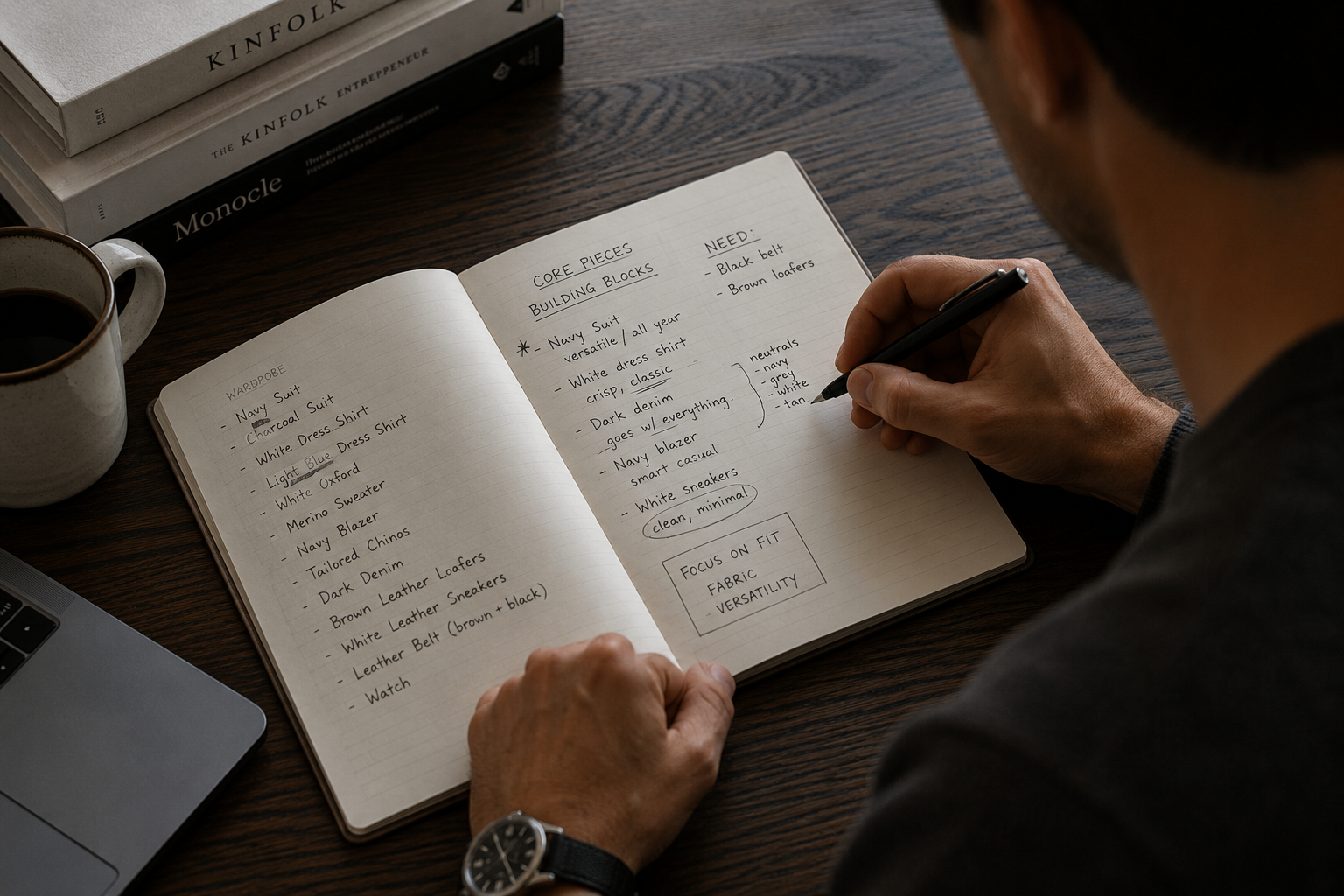
The 12 Core Pieces I Build Around
A professional wardrobe doesn't need to be overwhelming.
When the right core pieces are in place, you can create a wide range of outfits without owning an excessive amount of clothing or having to think too hard about what goes with what.
The exact wardrobe will always depend on the man, his profession, and how he actually spends his week, but these are 12 pieces I often build around.
1. Navy Suit
A navy suit is one of the most versatile pieces a man can own.
It works for client meetings, presentations, formal events, dinners, and most business settings where you need to look polished without feeling overly formal.
Keep the styling simple and the fit exceptional, and you'll have something you can rely on for years.
2. Charcoal Suit
A charcoal suit gives you another strong option when the occasion calls for something slightly more formal or understated.
It's particularly useful for important meetings, presentations, evening events, and more traditional professional environments.
Between navy and charcoal, you can cover a significant portion of the occasions that genuinely require a suit without filling your closet with versions you rarely wear.
3. Navy Blazer
A navy blazer is one of the easiest ways to bridge the gap between a full suit and business casual.
Pair it with grey trousers and a dress shirt for a more traditional look, or wear it with chinos, knitwear, or even dark denim when the setting allows for something more relaxed.
It's useful precisely because it doesn't belong to only one type of outfit.
4. Grey Trousers
Grey trousers are one of the hardest-working pieces in a professional wardrobe.
They pair naturally with navy, white, light blue, brown, black, and a range of more subtle colors, which means they can support a surprising number of combinations.
A good pair should feel polished enough for work without looking like the bottom half of a suit you're trying to wear separately.
5. Structured Dark Trousers
An additional pair of dark trousers in navy or charcoal gives you more rotation throughout the week while keeping the wardrobe cohesive.
They can work with dress shirts, polos, knitwear, and jackets depending on the level of formality you need.
The goal is to give yourself another option without introducing something that only works one way.
6. Two White Dress Shirts
There's a reason the white dress shirt remains a professional staple.
It works with virtually every suit, blazer, and trouser combination in this wardrobe and can move easily between a normal workday and a more formal meeting.
Having at least two in rotation also means you aren't relying on the same shirt every time you need to dress up.
7. Light Blue Dress Shirt
A light blue dress shirt gives you an easy alternative to white while remaining just as versatile.
It pairs especially well with navy, charcoal, grey, and brown and tends to work across a wide range of professional settings.
It's subtle, but that little bit of variation makes a wardrobe feel much less repetitive.
8. Subtle Pattern Shirt
Once your solid shirts are covered, a subtle stripe or understated pattern can add some personality without making the shirt difficult to wear.
The key is restraint.
You want enough interest to give your wardrobe variety, but not so much that the shirt dictates the rest of the outfit.
9. Merino Wool Sweater
A lightweight merino sweater in navy, charcoal, or another versatile neutral is incredibly useful when you want to look polished without wearing a jacket.
Wear it over a dress shirt, underneath a blazer, or on its own with tailored trousers or chinos.
It also gives your professional wardrobe more range for travel, cooler weather, and workplaces where a suit would feel unnecessarily formal.
10. Dark Denim
For smart-casual professional environments, clean dark denim can be an excellent option.
The key is keeping it polished: minimal fading, no distressing, and a fit that complements your proportions.
Paired with a blazer, knit, polo, or casual button-down, dark denim can move easily between a relaxed office, a coffee meeting, and dinner after work without looking like weekend clothing.
11. Brown Leather Belt and Shoes
Brown leather adds warmth and versatility to a professional wardrobe.
It works particularly well with navy, grey, chinos, and many smart-casual combinations. Depending on your workplace, a refined brown loafer or lace-up can also transition easily between more formal and relaxed outfits.
Your belt doesn't need to match your shoes perfectly, but the two should feel intentional together.
12. Black Leather Belt and Shoes
Black leather still has an important place in a professional wardrobe, particularly for more formal or traditional settings.
It's a natural choice with charcoal and darker tailoring and gives you an option when brown would feel too casual for the occasion.
Again, you don't need several versions. One excellent pair of black shoes and a simple black belt can cover what you need.
Why This Framework Works
The strength of this wardrobe isn't any one individual piece. It's the fact that the pieces support one another.
Your navy blazer works with your grey trousers. Your white and blue shirts work with both suits. Your knitwear works with trousers, denim, and jackets. Your shoes have multiple applications instead of belonging to one specific outfit.
That's the idea behind building a wardrobe as a complete system.
You're not starting from scratch every morning or asking yourself whether one piece goes with another. Most of those decisions have already been made through the way the wardrobe was built.
That's what makes getting dressed easier.
Where Many Professional Wardrobes Break Down
Most wardrobes don't become inconsistent overnight. It usually happens one purchase at a time.
You buy a jacket you liked in the store, a shirt because it was on sale, or a pair of shoes that looked great on their own. None of those purchases are necessarily bad.
The problem is that they weren't chosen in relation to everything else you own.
Over time, you end up with plenty of clothing but surprisingly few combinations you actually want to wear.
That's usually not a quantity problem. It's a cohesion problem.
And if your career, responsibilities, or lifestyle have changed significantly since you bought most of your clothing, it may also be one of the signs you've outgrown your wardrobe.
A Practical Reset
If your professional wardrobe feels scattered, don't start by shopping.
Start by looking at what you already own.
Pull out the pieces you wear regularly and feel good in. Try on anything you haven't worn in a while and pay attention to the fit. Set aside pieces that feel dated, no longer fit properly, or are consistently difficult to pair with the rest of your wardrobe.
Then look at what's missing.
You may discover that you don't need a completely new wardrobe at all. You might need better-fitting trousers, another layer, updated shoes, or a few shirts that connect pieces you already own.
That's why I prefer to approach a wardrobe strategically rather than starting with a shopping list. The goal isn't to replace everything. It's to understand what works, identify the gaps, and build from there.
Final Thought
Your professional wardrobe should make your life easier, not add another decision to your day.
When the fit is right and your pieces work together, you’re prepared for meetings, travel, dinners, and everything in between—without having to think too hard about what to wear.
That’s what a well-built wardrobe should do: support your career, lifestyle, and how you want to show up.
My Private Wardrobe Advisory manages that process from start to finish—from assessing what you own and identifying what’s missing to sourcing, tailoring, and bringing everything together.
If your wardrobe no longer reflects where you are today, book a Private Consultation.

BRANDI HEARN
Strategic Menswear Advisor · Los Angeles
Brandi Hearn is a Strategic Menswear Advisor with more than a decade of experience helping accomplished men build intentional wardrobes around their careers, lifestyles, and how they want to show up.