
The Curarte Neutrals Map: The Starting Point for a Sharper Wardrobe
Written by Brandi Hearn
Most men start building a wardrobe by asking what they need.
A navy suit. A few shirts. Dark denim. Maybe another jacket.
But before deciding what to buy, there’s a more important question:
What colors are going to hold all of it together?
You can own all the right pieces and still have a wardrobe that feels disconnected if the colors don’t work with one another—or with you.
That’s where neutrals come in.
The right neutral palette gives the wardrobe a foundation. Your trousers work with more of your shirts. Your jackets work across more outfits. Your knitwear layers naturally. Your shoes make sense with what you’re wearing.
Instead of simply owning more clothing, you get more out of what you already own.
Navy, grey, black, and white are common starting points, but I don’t believe every man should automatically build around the same colors.
Your coloring matters. Your profession matters. Your lifestyle matters. And how you want to present yourself matters.
That’s why I use a Curated Neutrals Map when building a client’s wardrobe. Before we start filling gaps, I establish the colors that will give his wardrobe the strongest foundation.
Why Neutrals Matter More Than You Think
Neutrals aren’t simply the safe colors in your closet.
They’re what make the rest of your wardrobe work.
Think about a navy jacket that works with grey trousers, stone chinos, dark denim, a white shirt, a blue shirt, several polos, and multiple pieces of knitwear.
Now compare that with a jacket you like just as much but can only figure out how to wear one way.
One is an attractive piece of clothing.
The other is an asset to your wardrobe.
That’s the thinking behind building a wardrobe as a complete system. Every piece doesn’t need to work with everything, but the pieces you rely on most should connect naturally.
A strong neutral foundation creates those connections.
You get more combinations, shopping becomes more strategic, and getting dressed requires far less guesswork.
That’s real versatility—not having more choices, but having better ones.
Start With Your Base Neutrals
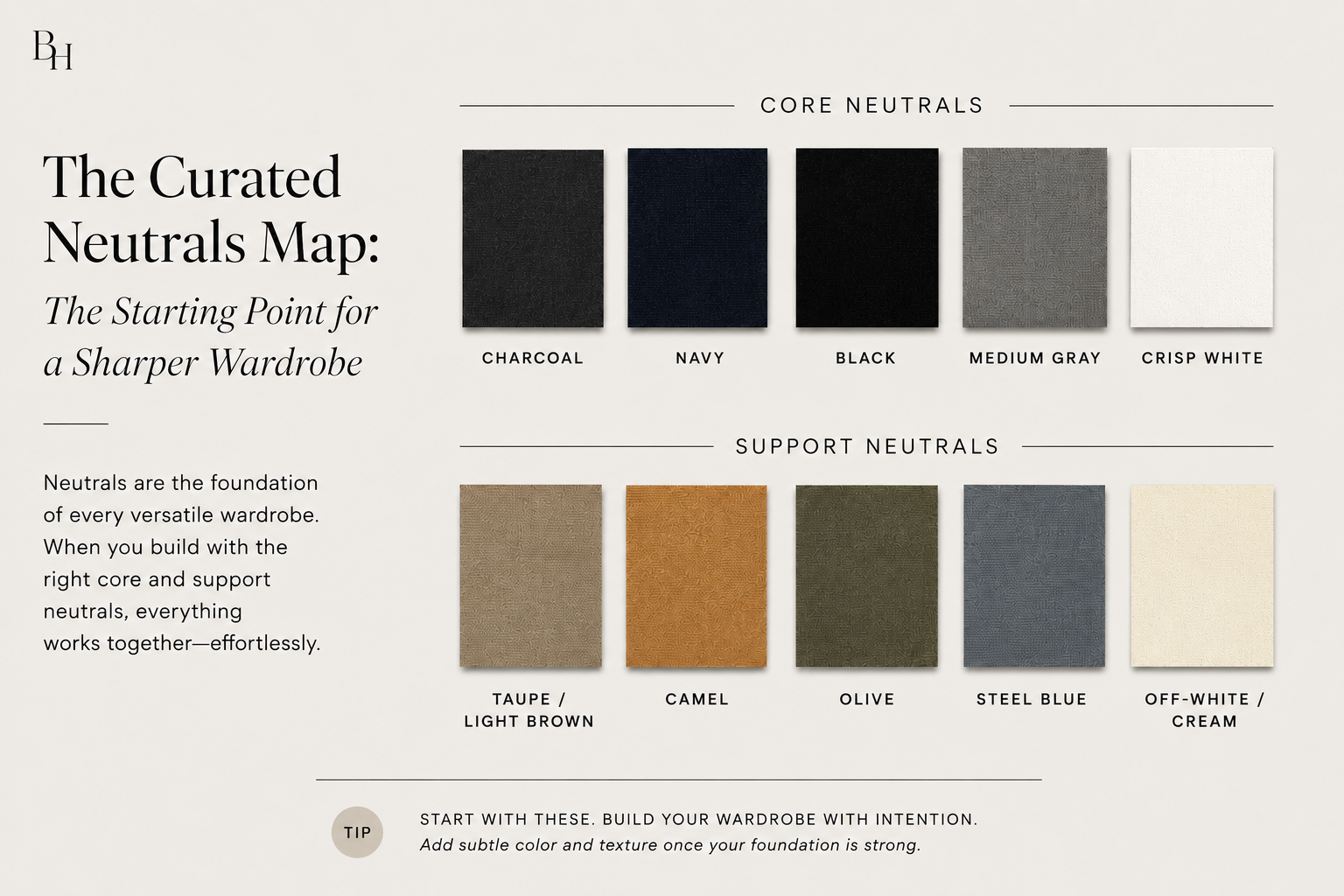
I divide neutrals into two categories: base neutrals and support neutrals.
Your base neutrals do most of the heavy lifting.
They’re the colors that show up throughout the pieces you rely on most: suits, jackets, trousers, denim, shirts, T-shirts, and sometimes shoes.
Common base neutrals include:
Charcoal grey
Navy
Black
Medium grey
White
But this isn’t a checklist.
You don’t need all five simply because they’re traditional menswear colors.
A man working in a conservative professional environment might build heavily around navy, charcoal, white, and black.
Someone with a more relaxed professional life may get considerably more use from navy, stone, olive, brown, and softer neutrals.
Your core colors should reflect your life—not a generic list of what every man is supposed to own.
Add Support Neutrals for Range
Once the foundation is established, support neutrals keep the wardrobe from feeling repetitive.
These might include:
Taupe
Camel
Olive
Steel blue
Cream
Off-white
Stone
I often use these for knitwear, casual trousers, overshirts, jackets, polos, and other pieces that sit around the core wardrobe.
This is where you can create more dimension without sacrificing versatility.
Dark denim, a camel knit, and a charcoal jacket are three distinct colors, but the outfit doesn’t feel busy because the colors relate naturally to one another.
Support neutrals can also shift with the season.
Cream, stone, off-white, and lighter greys can open up a wardrobe during warmer months. Charcoal, navy, deeper olive, brown, and black can give it more depth during cooler seasons.
A neutral wardrobe doesn’t have to look neutral.
Done well, it can have considerable depth, texture, and personality.
Your Best Neutrals Should Work With You
This is where generic color advice tends to fall short.
A color can be versatile and still not be particularly good on you.
Put the same shade of grey on two different men and you can get two very different results. On one, it creates definition and contrast. On another, it can flatten his coloring and make him look washed out.
That’s why I don’t give every client the same palette.
Natural coloring and contrast matter, particularly with shirts, polos, knitwear, jackets, and anything else worn close to the face.
But coloring is only part of it.
Your lifestyle and professional environment should influence the palette too.
Someone spending his week in executive meetings has different wardrobe requirements from someone working in a creative industry. A man living in Los Angeles may use his neutrals differently from someone navigating four distinct seasons in New York.
The goal isn’t to find the universally “best” neutrals. It’s to identify the best neutrals for you.
A Good Color Palette Should Make Shopping Easier
One of the biggest advantages of establishing your neutrals is that they give you a filter for future purchases.
Instead of walking into a store and asking, Do I like this?
You can ask something more useful:
What will this do for my wardrobe?
Does the jacket work with the trousers you already own?
Can the sweater be worn with your denim and your chinos?
Do the shoes connect with enough of your wardrobe to justify adding them?
Does the color fill an actual gap, or are you buying another version of something you already have?
That changes the way you shop.
You’re no longer looking at each piece in isolation. You’re looking at what it contributes to the wardrobe as a whole.
And that’s how you stop accumulating clothes and start building something intentional.
Look at What You Already Own Before Adding More
Once you know which colors you want to build around, take a look at your current wardrobe.
Don’t shop yet.
Start with what you already have.
Which colors show up repeatedly?
Which pieces are easiest to wear?
Which ones always seem difficult to pair?
Are there colors you keep buying because you like them individually, even though they don’t connect with much else?
Sometimes the gap is smaller than you think.
You may be missing one pair of trousers that would make several jackets useful. A few well-chosen shirts may create combinations you didn’t have before. Or you may realize you’ve accumulated so many unrelated colors that the wardrobe has lost any real sense of cohesion.
Color isn’t the only part of this assessment. A perfectly coordinated palette won’t compensate for clothing that doesn’t sit properly on your body, which is why fit is another critical part of the wardrobe foundation.
And if much of what you own no longer feels relevant to your life, it may be worth asking whether you’ve simply outgrown your current wardrobe before investing in more.
The Goal Is a Wardrobe That Connects
Establishing your neutrals isn’t about restricting what you can wear.
It’s about giving everything else somewhere to go.
Once the foundation is cohesive, you have far more freedom to introduce pattern, texture, seasonal colors, and pieces with more personality because there’s already something anchoring them.
That’s why I don’t look at color separately from the rest of a client’s wardrobe.
It has to work with his coloring. His proportions. His profession. His lifestyle. What he already owns. And where he actually needs to get dressed for.
The goal isn’t a perfectly color-coordinated closet.
It’s opening your wardrobe and knowing that most of what you see can actually be worn together.
It’s getting more combinations from fewer pieces.
It’s buying something new because it strengthens your wardrobe—not simply because you liked it in the store.
And it’s getting dressed without solving the same color puzzle every morning.
For men who want that foundation built around their individual lifestyle, coloring, proportions, and professional needs, my Private Wardrobe Advisory takes this same strategic approach across the entire wardrobe.
Your neutrals may not be the most noticeable part of your wardrobe.
But they’re the reason everything else works.

BRANDI HEARN
Strategic Wardrobe Advisor · Los Angeles
Brandi Hearn is a Strategic Wardrobe Advisor with more than a decade of experience helping accomplished men build intentional wardrobes around their careers, lifestyles, and how they want to show up.