
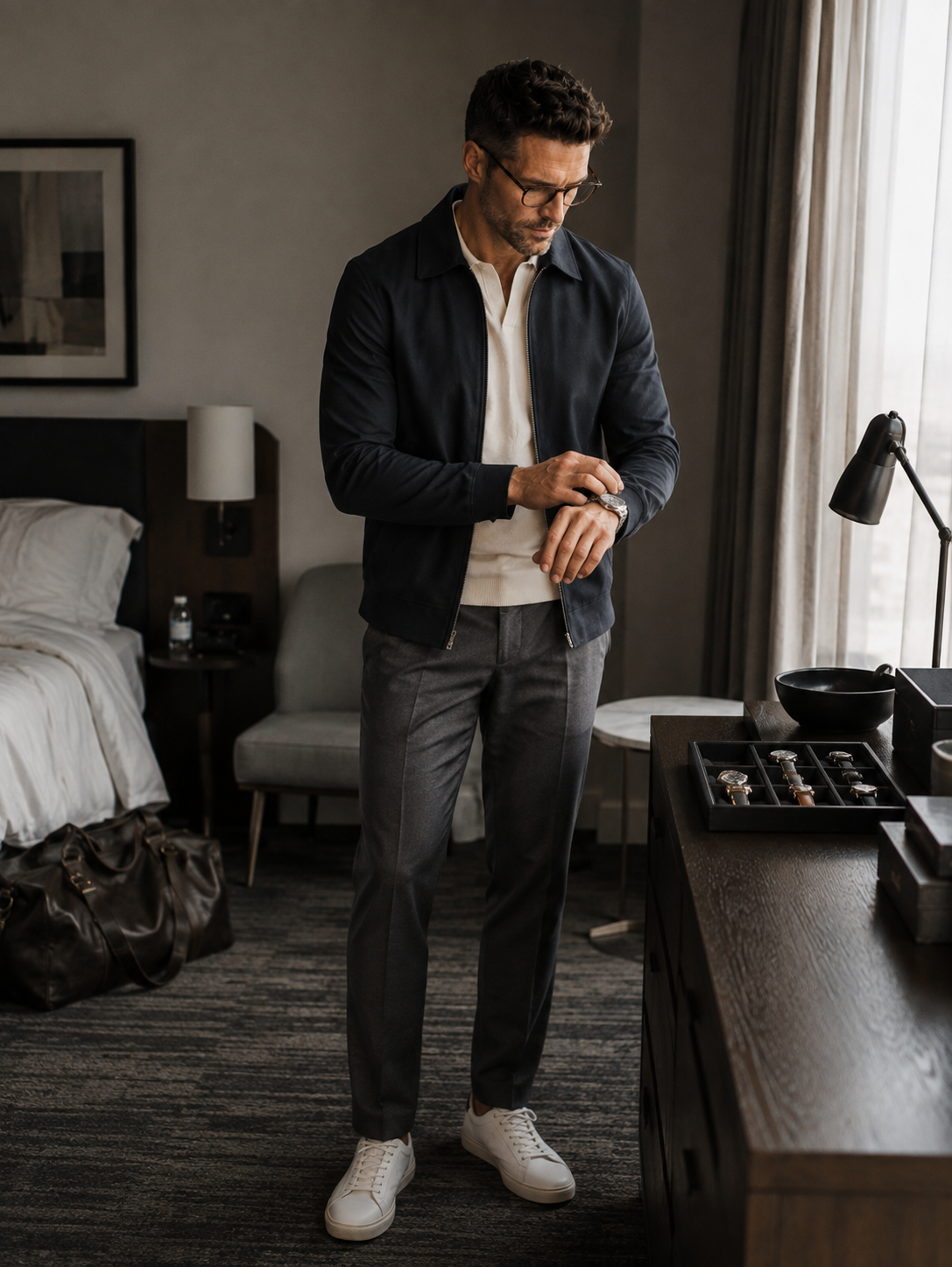
Written by Brandi Hearn
Turning 40 doesn't mean you suddenly need an entirely different wardrobe.
But it is often the point when men start noticing that what worked ten or fifteen years ago doesn't quite work anymore.
Your career may have evolved. Your body may have changed. Your lifestyle probably looks different. And the clothes you've accumulated along the way don't always reflect the man wearing them today.
That's really what dressing well in your 40s is about.
Not dressing "younger." Not dressing older. And definitely not following a list of arbitrary rules about what a man over 40 should or shouldn't wear.
It's about refining your wardrobe so it feels appropriate for where you are now.
Here's where I would start.
1. Get More Particular About Fit
Fit matters at every age, but your 40s are a good time to stop accepting clothing that almost fits.
The shirt that's slightly too tight through the stomach.
The blazer you've had for eight years that's pulling across the chest.
The jeans that technically button but aren't doing much for your proportions.
Your body changes over time, and your wardrobe needs to change with it.
That doesn't automatically mean buying everything new.
Sometimes the difference is tailoring. Sleeves can be shortened. Trousers can be hemmed. Shirts can often be refined through the body.
Other times, you simply need a different cut.
My complete guide to how men's clothes should fit breaks down what to look for across shirts, jackets, trousers, and denim.
Don't dress for the body you had at 30. Dress exceptionally well for the body you have now.
2. Upgrade the Pieces You Wear Most
One of the biggest misconceptions about upgrading your style is that you need to replace your entire wardrobe.
You usually don't.
Start with the pieces you wear constantly.
If you live in T-shirts, improve your T-shirts.
If you wear chinos four days a week, find chinos that fit exceptionally well.
If your professional wardrobe revolves around business casual, invest there rather than buying another suit you might wear twice a year.
A strong wardrobe in your 40s might include:
Well-fitting T-shirts and polos
Quality denim
Refined chinos or trousers
Versatile knitwear
A casual jacket
A navy blazer
Clean sneakers
Loafers or leather shoes
A few excellent dress shirts
The exact list will be different for every man.
That's the point.
Your wardrobe should be built around your actual life—not someone else's list of essentials.
3. Stay Current Without Chasing Trends
There's a difference between looking current and looking trendy.
You don't need to suddenly adopt whatever silhouette happens to be dominating menswear this season.
But you also don't want your wardrobe frozen in 2012.
Pay attention to proportion, trouser shapes, jacket lengths, footwear, fabrics, and how clothing is being worn now.
Sometimes a small change is enough.
A more contemporary trouser.
A textured knit instead of another button-down.
A suede jacket instead of the same quarter-zip you've worn for years.
Updated eyewear.
Cleaner sneakers.
The goal is evolution, not reinvention.
If you've started feeling like your clothing belongs to an earlier version of yourself, there may be other signs you've outgrown your current wardrobe.
4. Stop Confusing Comfort With Oversized
Comfort becomes increasingly important as you get older.
That's a good thing.
But comfortable clothing doesn't need to be shapeless.
Modern fabrics give you plenty of options that move well while still maintaining structure.
Look for:
Cotton with subtle stretch
Lightweight wool
Merino
Linen and linen blends
Soft structured knits
Quality performance fabrics when appropriate
The objective is clothing that moves with you rather than restricts you.
And don't automatically size up because you want more room.
Excess fabric can actually make you appear larger and less proportioned.
Comfort should come from the right fit and fabric—not simply more fabric.
5. Build More Versatility Into Your Wardrobe
By your 40s, your life may require you to dress for a lot of different situations.
Work.
Dinner.
Travel.
Dates.
Weekends.
Client meetings.
Events.
You shouldn't need a completely separate wardrobe for every one.
A navy blazer that works with trousers, chinos, and dark denim is valuable because it moves between settings.
The same applies to a great polo, lightweight knit, casual jacket, or pair of loafers.
That's why I prefer building a wardrobe as a complete system rather than collecting individual outfits.
The more your pieces connect, the fewer clothes you actually need.
6. Let Accessories Finish the Look
This is also a good time to become more selective about accessories.
You don't need many.
You need the right ones.
A quality watch.
A good leather belt.
Sunglasses that complement your face.
A streamlined bag or briefcase if your lifestyle calls for one.
Maybe a simple bracelet or other piece that feels distinctly like you.
Accessories should add something to the outfit without fighting for attention.
I think of them as the finishing details that bring the wardrobe together.
Understated doesn't mean forgettable. It means knowing where to stop.
7. Pay Attention to Grooming Too
A polished wardrobe can only do so much if everything surrounding it has been neglected.
Hair.
Facial hair.
Skin.
Nails.
Fragrance.
These aren't separate from personal style. They're part of the complete picture.
You don't need an elaborate grooming routine any more than you need an elaborate wardrobe.
You need consistency.
The goal is for everything about your appearance to feel equally considered.
8. Take Better Care of Better Clothing
As the quality of your wardrobe improves, maintenance becomes more important.
Use proper hangers.
Fold knitwear rather than stretching it over hangers.
Rotate your shoes.
Condition leather.
Deal with stains quickly.
Have small repairs handled before they become large ones.
And know when something has simply reached the end of its life.
A stretched collar, faded polo, badly worn shoe, or pilled sweater can quietly bring down an otherwise polished outfit.
Sometimes upgrading your wardrobe means subtracting rather than adding.
9. Stop Dressing for Who You Used to Be
This may be the most important one.
It's easy to keep buying versions of what you've always worn.
The same jeans.
The same shirts.
The same brands.
The same combinations.
But your 40s can be an opportunity to ask a better question:
Does the way I dress now actually reflect the man I've become?
Maybe your career has advanced considerably.
Maybe you're more social.
Maybe you're dating again.
Maybe you're traveling more.
Maybe you simply know yourself better and don't feel the need to prove as much through your clothing.
Your wardrobe should reflect those changes.
Not dramatically.
Naturally.
Final Thought
Dressing well in your 40s isn't about trying to look 30.
And it certainly isn't about deciding that you're now too old to wear certain things.
It's about clarity.
You know your body better.
You know your lifestyle better.
You know what you actually wear.
Now your wardrobe should catch up.
Get the fit right. Upgrade what you use most. Remove what's no longer serving you. Stay current without chasing trends. And build enough cohesion that getting dressed doesn't require much thought.
That's the same approach I take through my Private Wardrobe Advisory, where the wardrobe is built around the individual—his proportions, career, lifestyle, preferences, and the places he actually needs to show up.
Your 40s don't require a new style.
They require a more refined version of your own.

BRANDI HEARN
Strategic Wardrobe Advisor · Los Angeles
Brandi Hearn is a Strategic Wardrobe Advisor with more than a decade of experience helping accomplished men build intentional wardrobes around their careers, lifestyles, and how they want to show up.