
The Art of Layering: Men’s Tips to Avoid Bulkiness
Written by Brandi Hearn
Layering is one of the easiest ways to make a simple outfit more interesting.
A T-shirt on its own is straightforward. Add a fine-gauge knit and a lightweight jacket, and suddenly the outfit has more depth, texture, and dimension.
But there's a fine line between layered and bulky.
When too many heavy fabrics are stacked together—or the proportions aren't right—the outfit can quickly start to feel crowded.
The goal isn't to wear more layers.
It's to make each layer work with the one underneath it.
Here's how to do it.
1. Start With a Lightweight Base
Your first layer sets up everything that comes after it.
Keep it relatively lightweight and close to the body so you're not creating unnecessary volume before you've even added a jacket.
Good options include:
Quality cotton T-shirts
Lightweight long-sleeve shirts
Fine-gauge merino knits
Well-fitting button-downs
Think about a white T-shirt under a merino sweater and suede jacket.
The T-shirt almost disappears, but it gives the other layers something clean to build on.
The closer you are to the body, the lighter the layer should generally be.
2. Build From Light to Heavy
One of the simplest ways to layer men's clothing well is to gradually increase the weight and structure of each piece.
For example:
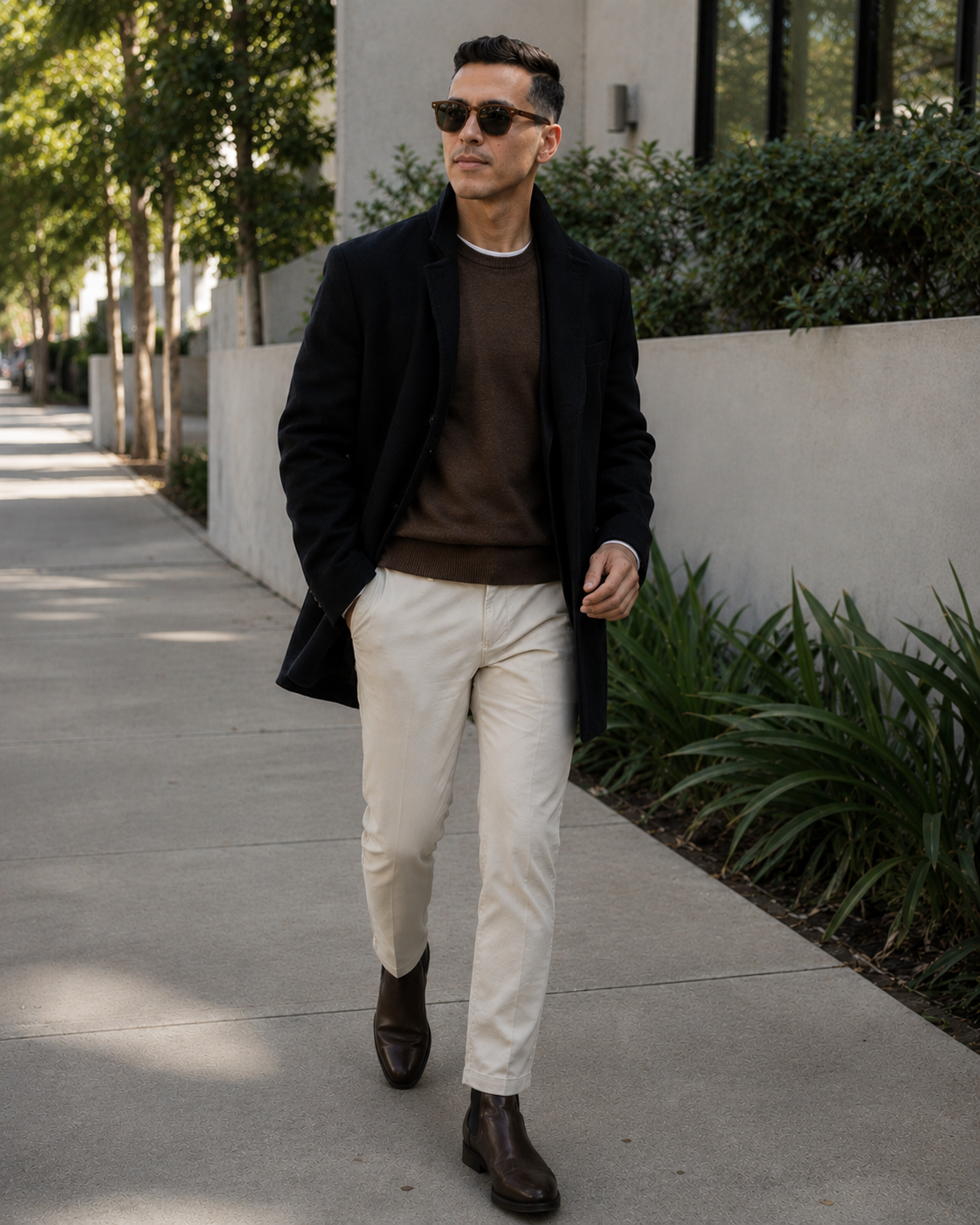
Cotton T-shirt → merino sweater → wool jacket
Or:
Button-down → lightweight knit → overcoat
The thinner pieces sit closest to the body, while the heavier, more structured pieces create the outer silhouette.
This keeps the outfit from looking overstuffed and allows each layer to sit naturally.
It also means you can remove the outer layer and still have an outfit that works underneath.
3. Pay Attention to Proportion
Bulk isn't always caused by thick fabric.
Sometimes it's a proportion problem.
An oversized sweater underneath a slim jacket will bunch through the body and sleeves. A long shirt underneath a short jacket can create awkward breaks. Several loose layers stacked together can overwhelm your frame.
Instead, create some contrast between the pieces.
A slimmer knit can sit underneath a slightly roomier jacket.
A fitted shirt can balance a more relaxed overshirt.
A longer coat can create structure over softer layers underneath.
Each layer should have enough room for the one beneath it without making the overall silhouette larger than it needs to be.
4. Fit Still Matters
Layering doesn't fix poor fit.
In fact, it usually makes it more obvious.
Each piece should fit properly on its own and allow enough room for the way you intend to wear it.
A jacket that fits beautifully over a T-shirt may become too tight once you add a sweater underneath. If the shoulders pull, the sleeves feel restrictive, or the jacket creates tension across the chest, the combination isn't working.
That's why understanding how men's clothes should fit becomes particularly important when you're layering.
You want structure without restriction and shape without unnecessary volume.
5. Use Texture to Create Depth
You don't need a lot of color or pattern to make a layered outfit interesting.
Texture can do much of that work for you.
Picture:
Dark denim + cream merino knit + brown suede jacket
Or:
Grey trousers + white shirt + charcoal wool overshirt
The colors are simple, but the difference between denim, merino, suede, cotton, and wool gives the outfit dimension.
This is one of my favorite ways to make a neutral wardrobe feel more interesting without making it busier.
6. Keep the Color Palette Cohesive
Layering naturally puts more clothing—and therefore more color—into one outfit.
If every layer introduces a completely different color, the outfit can start to feel fragmented.
Instead, work within a relatively tight palette.
Navy with blue and grey.
Cream with camel and brown.
Charcoal with black and softer grey.
Olive with cream and brown.
Once you've established the right neutral colors for your wardrobe, layering becomes considerably easier because the pieces already have a natural relationship to one another.
You can still introduce contrast.
You just don't need every layer to create it.
7. Let One Layer Do the Work
Not every piece needs to be interesting.
If you're wearing a beautiful suede jacket, the shirt and trousers can be simple.
If your coat has a strong texture, you don't necessarily need a patterned sweater underneath it.
If you're layering several neutral pieces, one contrasting fabric or color may be all the outfit needs.
This is part of building a wardrobe where the pieces work together rather than treating every garment as an individual statement.
One layer can have presence. The others can support it.
8. Keep Accessories Simple
Once you're wearing multiple layers, there's already more happening visually.
Your accessories don't need to compete with them.
A watch, scarf, sunglasses, or gloves can finish the outfit, but choose them with the same restraint you use with the clothing.
As with men's accessories in general, focus on proportion, texture, and how the piece relates to everything around it.
The goal is to add the final detail—not another focal point.
Final Thought
Good layering shouldn't look complicated.
You might be wearing three or four pieces, but visually, they should read as one complete outfit.
Start light. Gradually add weight and structure. Pay attention to proportion. Keep the colors connected. And use texture to create interest instead of relying on more and more pieces.
When the fabric weight, fit, proportion, and color all work together, layering adds depth without adding bulk.
For men who want those combinations already considered as part of their wardrobe, my Private Wardrobe Advisory looks at how individual pieces work together across seasons, settings, and different levels of formality.
The best layering adds dimension to the outfit—not size to the man wearing it.

BRANDI HEARN
Strategic Wardrobe Advisor · Los Angeles
Brandi Hearn is a Strategic Wardrobe Advisor with more than a decade of experience helping accomplished men build intentional wardrobes around their careers, lifestyles, and how they want to show up.