
Written by Brandi Hearn
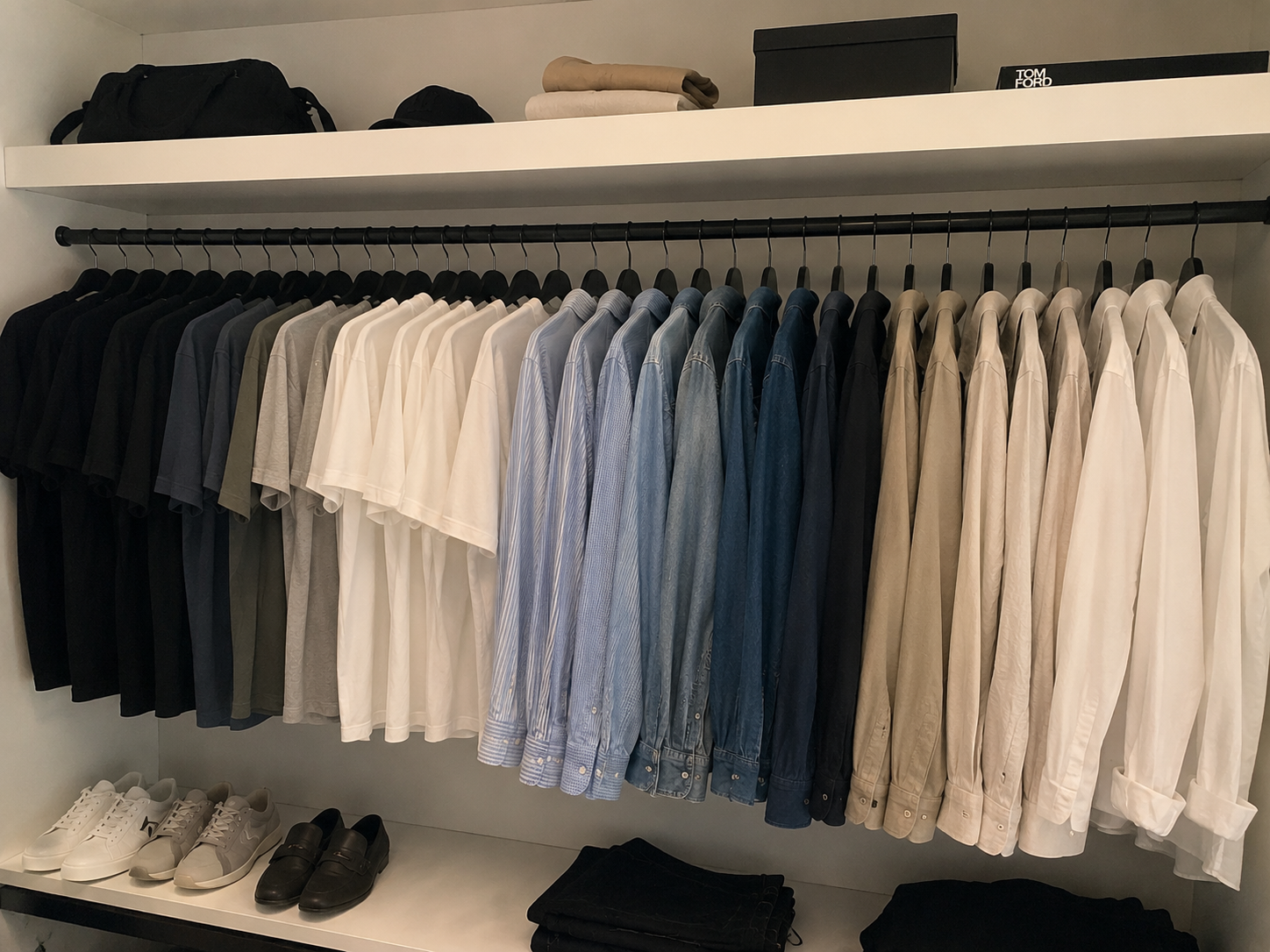
A strong rotation should carry you through work, dinners, travel, weekends, and events without feeling like you need a completely different wardrobe for each part of your life.
When I'm building a client's wardrobe, that's what I'm looking at. Not just whether a shirt looks good on its own, but how it fits his proportions, where he'll actually wear it, and how easily it works with everything else.
The exact mix will look different for every man, but these six styles are a strong place to start.
1. The Solid-Colored T-Shirt
Brands to Consider: Reiss, Banana Republic, H&M
A T-shirt is one of the simplest pieces you can own, but that doesn't mean just any T-shirt will do.
With something this minimal, fit, fabric, and condition become even more noticeable.
Look for cotton with enough weight to hold its shape and drape well. The shoulder seams should sit where your natural shoulder ends, the sleeves should frame your upper arms without squeezing them, and the body should follow your shape without clinging.
Start with white, navy, black, and grey. They'll give you the most versatility and work easily with denim, chinos, tailored trousers, and casual jackets.
Pair a clean T-shirt with dark denim, leather sneakers, and a suede bomber for the weekend, or wear one with tailored trousers and an unstructured jacket when you want to elevate it.
Pro tip: Get your core neutrals right first. Then add olive, brown, stone, or other colors that work with your complexion and the rest of your wardrobe.
2. The Formal Dress Shirt
Brands to Consider: Reiss, Bonobos, Charles Tyrwhitt
There are certain occasions when nothing replaces a proper dress shirt.
Start with white, then light blue. Both work effortlessly with navy, charcoal, and grey tailoring and give you a reliable foundation for meetings, weddings, formal events, and business dinners.
This is also one of those pieces where fit makes an enormous difference. Pay attention to how the collar frames your face, where the shoulders sit, whether there's pulling across the chest, and how much excess fabric you're carrying around the waist.
A great suit won't look nearly as good with a poorly fitting shirt underneath it.
And one important distinction: traditional dress shirts are meant to be tucked in. If you want something you can wear untucked with denim or chinos, choose a shirt specifically cut with a shorter hem.
Your dress shirt doesn't need to be the most interesting thing you're wearing. It needs to fit exceptionally well and do its job.
3. The Oxford Button-Down
Brands to Consider: Ralph Lauren, Proper Cloth, Todd Snyder
The Oxford button-down is one of those pieces I find myself recommending often because it gives you so much range.
It's more relaxed than a traditional dress shirt, but still polished enough to work in many professional and social settings.
Start with white or light blue. Once those are covered, a subtle stripe is an easy way to introduce some variety.
Wear yours with chinos and loafers for business casual, dark denim and a casual jacket for dinner, or underneath a crewneck sweater when you want another layer.
Depending on the cut, you can also wear an Oxford tucked or untucked, which gives you even more flexibility.
It's not necessarily the shirt that gets the most attention. It's the one you'll find yourself wearing in more ways than you expected.
4. The Chambray Shirt
Brands to Consider: Mr. Porter, Quince, The Tie Bar
Chambray gives you some of the character of denim without the weight, making it a great option when you want something casual with a little more texture.
Wear it open over a clean T-shirt on the weekend, pair it with chinos and suede loafers, or tuck it into trousers and add an unstructured jacket when you want to dress it up a bit.
I prefer cleaner chambray shirts without excessive fading, contrast stitching, or unnecessary detailing. The simpler the shirt, the easier it is to work into different outfits.
That's what makes chambray useful: it adds enough interest to change the look without becoming difficult to style.
5. The Polo Shirt
Brands to Consider: Paige, Theory, H&M
The polo is what I reach for when a T-shirt feels too casual, but a button-down feels like more than the occasion requires.
It gives you that middle ground.
For a more elevated look, I particularly like knit polos and quality cotton styles with a collar that actually holds its shape. Skip anything overly thin, shiny, heavily branded, or too athletic-looking.
Fit matters here, too. The polo should skim the torso rather than cling to it, and the sleeves should sit neatly around the upper arm.
Start with navy, black, white, or charcoal.
Wear one with tailored trousers and loafers for dinner, chinos and leather sneakers for the weekend, or underneath a soft-shouldered jacket for a more relaxed professional look.
A good polo doesn't have to make a statement. It just makes you look pulled together without looking like you tried too hard.
6. The Linen Shirt
Brands to Consider: Bonobos, The Men's Store at Bloomingdale's, Banana Republic
When the weather gets warmer, you still want to look put together—you just need fabrics that make sense for the temperature.
That's where linen earns its place.
A good linen shirt gives you the breathability and ease you want for travel, vacations, outdoor dinners, summer events, and relaxed weekends without looking overly casual.
Look for linen with enough substance to drape cleanly through the body. If you prefer a little more structure, a linen-cotton blend is a great alternative.
Start with white, ivory, pale blue, stone, or soft olive.
Pair it with tailored shorts and loafers during the day, or lightweight trousers and suede footwear for dinner.
And don't worry about getting every wrinkle out. Linen is supposed to have some natural texture.
Relaxed is the point. Careless isn't.
The Final Take
These six shirts aren't meant to become another shopping checklist.
Your wardrobe should reflect how you actually live.
If you spend most of your week in a traditional professional environment, you may need several dress shirts and Oxfords. If your work and lifestyle are more relaxed, polos, elevated T-shirts, and casual button-downs may do far more for you.
What matters is having the right balance—and making sure the pieces you own actually work together.
That's where versatility comes from.
Before adding more shirts, take a look at what you already own. Which ones fit properly? Which do you actually wear? Which work across multiple parts of your life? And which are simply taking up space? A style audit of your wardrobe can make it much easier to see what's working, what needs replacing, and where the real gaps are.
From there, start with fit, proportion, fabric, color, and function. Then add pattern, texture, and more distinctive pieces once the foundation is right.
You may end up with fewer shirts than you have now.
But you'll have a lot more to wear.
Build a Wardrobe Around the Way You Actually Live
If your closet is full but you still find yourself reaching for the same few pieces, book a Private Consultation.
Through the Private Wardrobe Advisory, we'll look at your career, lifestyle, proportions, preferences, and what you already own to determine what stays, what's missing, and what will give you more range.
The goal isn't to keep adding clothes. It's to build a wardrobe where the right pieces are already there.

BRANDI HEARN
Strategic Wardrobe Advisor · Los Angeles
Brandi Hearn is a Strategic Wardrobe Advisor with more than a decade of experience helping accomplished men build intentional wardrobes around their careers, lifestyles, and how they want to show up.